Article IV — The Illusion of Separation: A Clinical-Transpersonal Dialogue Between Buddhism and A Course in Miracles
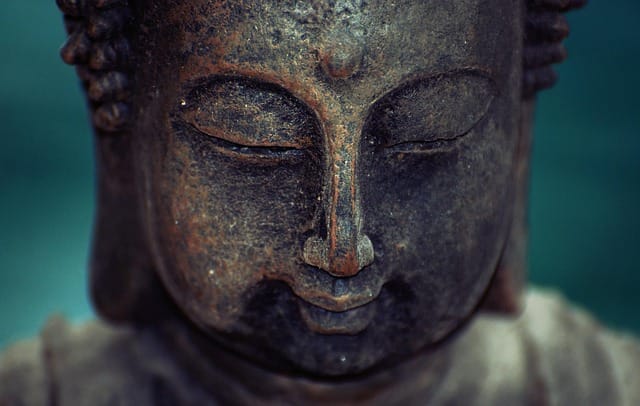
There are moments in clinical work—quiet, almost imperceptible—when the structure of a person’s suffering reveals itself not as trauma alone, nor conditioning alone, but as something more subtle: a misidentification.
Not a wound in the personality, but a confusion about what the personality is.
It is here that two seemingly distant traditions—Buddhism and A Course in Miracles—begin to speak in the same voice.
The Shared Diagnosis: A Mistaken Identity
Both systems begin with a radical proposition:
what we take ourselves to be is not, in any ultimate sense, real.
In Buddhist psychology, this appears as anatta—the absence of a fixed, enduring self. The “I” is revealed to be a composite: sensations, thoughts, perceptions, endlessly arising and dissolving.
In A Course in Miracles, the same misidentification is named differently: the ego. A constructed identity built upon the belief in separation from God, maintained through fear and defended through perception.
In clinical language, we might say:
«The suffering subject is not only wounded—it is mislocated.»
Both traditions are not primarily concerned with improving the self.
They are concerned with undoing the assumption that the self, as experienced, is what we are.
The World as Projection or Emptiness
As this inquiry deepens, the solidity of the world itself begins to soften.
Buddhism describes reality as śūnyatā—emptiness. Not nothingness, but the absence of inherent, independent existence. All phenomena arise interdependently, like reflections in a mirror, or images in a dream.
A Course in Miracles goes further into metaphysical territory: the world is not simply empty—it is illusory. A projection of the ego’s belief in separation. It is not created by God, and therefore lacks ultimate reality.
Clinically, this distinction matters less than it first appears.
In both frameworks, perception is no longer trustworthy as a reflection of truth. It becomes instead:
«A conditioned interface, shaped by belief.»
The client who suffers is not only reacting to the world—they are inhabiting a constructed interpretation of it, one that appears absolute.
The Mechanism of Suffering
Despite their different vocabularies, both traditions locate the root of suffering in a similar movement:
- In Buddhism: craving, fueled by ignorance
- In ACIM: fear, arising from the belief in separation
Both describe a looping structure:
- A false perception is taken as real
- This generates emotional contraction
- The contraction reinforces the perception
From a therapeutic perspective, this resembles a closed perceptual system—self-validating, resistant to contradiction, and deeply embodied.
Importantly, neither system frames this as moral failure.
It is not sin.
It is not pathology in the conventional sense.
It is confusion sustained by identification.
The Path: Insight and Forgiveness
Where they diverge most clearly is in their method.
Buddhism offers direct observation:
through mindfulness and insight, the constructed nature of experience is seen clearly. With sufficient clarity, identification loosens. The illusion dissolves not through force, but through understanding.
A Course in Miracles offers forgiveness—though not in the interpersonal, moral sense. Forgiveness here is perceptual correction:
«“What I am seeing is not real, and I release it.”»
This is not denial, but a withdrawal of belief.
In a clinical setting, both processes can be observed:
- The moment a client sees a thought as a thought
- The moment a perception loses its emotional charge
- The moment the “other” is no longer experienced as a threat
These are micro-acts of awakening, whether named as insight or forgiveness.
No-Self and True Self
A crucial difference remains.
Buddhism ultimately refuses to replace the illusion of self with another identity. There is no enduring essence behind the aggregates—only openness, pro